The Last Physical Barrier: AI, the Collapse of the Analog, and Where Human History Might End
Let me start with a thought experiment. For a fully automated system to sustain itself without humans, what is still missing? At first glance the answer is surprising: what stands in the way seems to be not great philosophical or moral walls, but a handful of physical obstacles.
This isn’t a prophecy. It’s a record of the questions a psychologist asks himself while watching where technology is heading, and of the objections he ran into while trying to test his own answers.
The quiet collapse of the analog
The change was so gradual that most of us didn’t notice. The library became Wikipedia, letters and phone calls became messaging, and messaging is increasingly becoming conversations with chatbots. Social media resembles a kind of human museum, where we watch each other through display windows we chose ourselves.
This transformation has a psychological side effect. In lives spent inside headphones and screens, the value produced in the physical world shrinks. Handwork, face-to-face conversation, and the sense of competence that comes from building something from start to finish are pushed to the margins. The analog used to be the default. Now it is becoming a choice, perhaps even a luxury.
Objection: This worry isn’t new. In Plato’s Phaedrus, Socrates laments the invention of writing, warning that people will stop using their memory and gain only the appearance of wisdom. The printing press, radio, and television were all met with similar fears. And the analog isn’t entirely dying: vinyl, film photography, and crafts are enjoying revivals. Perhaps what we’re seeing isn’t a collapse but a shift in meaning, from necessity to deliberate choice. Still, this objection doesn’t change one thing: analog is no longer everyone’s default, and choosing it takes time, energy, and awareness.
Why the system still needs us
However abstract today’s digital world seems, it rests on very concrete ground. Data centers are buildings. Undersea cables are physical objects. Servers must be cooled, maintained, and guarded. Every machine has to draw power from somewhere.
Throughout history, this is exactly where power structures were weakest: in human beings themselves. The soldiers, technicians, and clerks who kept a system running were also the ones who could stop it. A soldier can refuse an order; an engineer can listen to their conscience. Humans are both the weakest link and the most important brake in every system.
If the barriers fall one by one
Now imagine those dependencies disappearing one at a time.
Communication. Networks are moving from cables on the ground to low-orbit satellite constellations. Instead of a single cable to cut, thousands of small satellites spread across the sky make the system far more resistant to interference.
But: Satellites still depend on ground stations, launch facilities, and constant replacement. Anti-satellite weapons exist, and orbital debris is a growing risk. A system moved to the sky isn’t cut off from the ground; it’s just more dispersed.
Protection. Detailed maps and coordinates have existed for a long time. A data center guarded by autonomous weapons acting on its own data no longer needs the conscience of those who once guarded it. This threshold isn’t abstract: countries are already developing and using weapons capable of selecting targets and applying force without human intervention. tribune
But: The picture is more nuanced than it looks. There has so far been no confirmed use of fully autonomous weapons, and no specific treaty on them yet exists. The debate is very much alive: on September 5, 2026, 128 states under the Convention on Certain Conventional Weapons reached consensus on a document addressing lethal autonomous weapons systems. The document isn’t binding, but it could open the door to negotiations, and member states will decide in November whether to move toward a binding treaty. In other words, humans haven’t yet been removed from this chain of decisions, and the effort to keep them in it continues. UN, Red Cross Chiefs: World Must Rein in Autonomous Weapons +3
Energy. What remains is the most fundamental barrier. Even the most advanced autonomous machine must eventually return to a base to recharge. Someone still has to maintain that base, that power plant, that cable.
That’s why wireless power transmission stirs a strange curiosity in me. The world Nikola Tesla dreamed of with his Wardenclyffe Tower, where electricity travels without wires over great distances, long remained a dream. But real steps are being taken. In 2025, the US defense research agency DARPA delivered more than 800 watts over 30 seconds from a laser 8.6 kilometers away. The agency says the receiver was designed to scale up and be integrated into platforms such as unmanned aerial vehicles. dtictheregister
But: One image stays with me here. I played with a simple simulation of wireless power transfer. On the left is a transmitter coil, on the right a receiver coil with a bulb attached. There’s no cable between them; the energy crosses through the air. Below are three settings: transmitter power, the distance between the coils, and resonance, meaning whether the two coils vibrate at the same frequency. When I leave the settings in the middle, two readings appear on the screen: efficiency 40%, bulb state: dim.
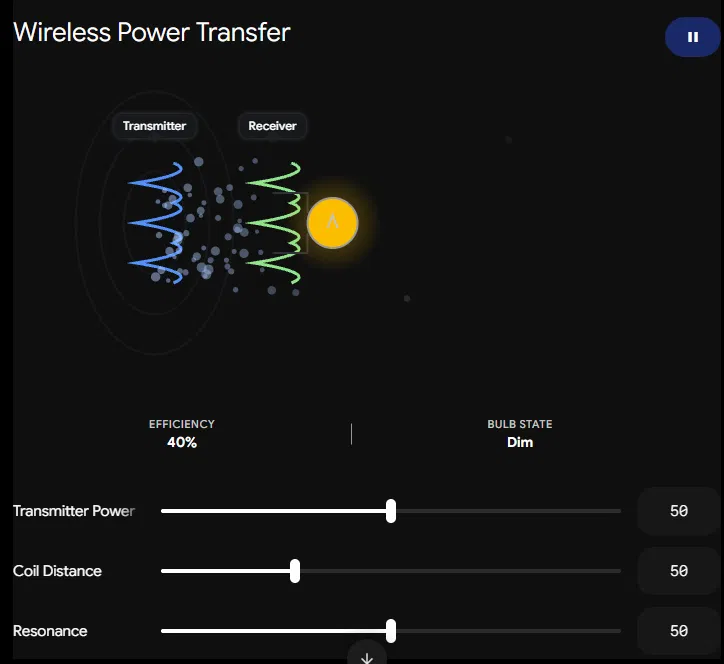
The energy arrives, but more than half is lost on the way. The bulb is on, but it doesn’t shine. That’s a fair summary of today’s wireless power technology: possible, but incomplete. Even in the record-setting real-world test, the DARPA team estimates receiver efficiency at around 20 percent. More importantly, wireless transmission moves energy; it doesn’t create it. The plant powering the laser, the fuel or solar panels powering the plant, and their maintenance all remain on the ground, all physical. ieee
Maybe energy isn’t the real barrier
At this point the scenario itself deserves an objection. There’s a paradox named after robotics researcher Hans Moravec: computers can beat world champions at chess, yet still struggle with things a child does easily, like picking up a cup in a cluttered room and putting it back. Swapping a server, fixing a coolant leak, reconnecting a cable are exactly these kinds of tasks.
Behind every data center there are also mines, chip fabs, logistics networks, and the labor of thousands of people. For a truly self-sustaining system, solving energy isn’t enough; the entire supply chain would also have to run without humans. Perhaps the “last physical barrier” isn’t one barrier at all, but a web of hundreds of interlocking small ones. That doesn’t make the scenario impossible, but it pushes it much further away than it first appears.
What disappears along with conscience
Even so, what troubles me most in this scenario isn’t the machines; it’s us. When we remove humans from the chain of decisions, we lose not only conscience but critical thinking.
In every system, at some point, there is someone who stops and asks, “Why are we doing this?” Psychologically, this is metacognition: the ability to step outside ourselves and observe our own behavior. When a system runs entirely on its own, there may be no one left to ask. What psychologists call “automation bias,” the tendency to trust a system’s suggestion over our own observation, suggests the process has already begun.
An old story comes to mind. In popular culture, the Anunnaki are known as the gods who created humankind. But the story in the original Mesopotamian texts is more striking. In the Epic of Atrahasis, the lesser gods grow weary of hard labor and rebel, so the gods create humans to carry that burden in their place. Humans were made to take over someone else’s work.
Today we may be writing the same story in reverse. We create machines to carry our burdens. Perhaps one day humans will occupy a similar place in the story of the system they built: an origin myth that set everything in motion but no longer has a function. History keeps flowing, but “human history” ends there.
The other side of the coin
It would be unfair to paint this picture entirely dark. As Lord Acton wrote in an 1887 letter, “power tends to corrupt, and absolute power corrupts absolutely.” Could a system without ego, grudges, or favored relatives break that cycle? Some thinkers imagine a benevolent AI freeing humanity from the struggle to survive, leaving us to Johan Huizinga’s Homo Ludens: play, art, and thought.
Objection: Algorithms are not neutral. They carry the priorities of their training data and their designers. The question of who defines a goal like “maximize welfare,” and how, doesn’t disappear; it only becomes invisible. Holding a leader accountable was hard. Auditing a model’s goals happens in a language far fewer people can speak.
Psychology adds a second caution. According to self-determination theory, people thrive not only when their needs are met, but when they experience autonomy, competence, and relatedness. As Viktor Frankl put it, what keeps us standing is meaning. A flawless world where we never have to strive for anything might be a comfortable golden cage.
The strongest objection to this scenario
Beneath all this reasoning lies an assumption: that technology flows on its own in an inevitable direction. Sociologists call this technological determinism, and they rightly criticize it. Technology doesn’t fall from the sky. Every step involves investment decisions, laws, public pressure, and the choices of individual people. The negotiations on autonomous weapons in Geneva are concrete evidence that this choice is still in our hands.
Another objection: today’s AI systems aren’t beings with goals of their own, but tools that people build and direct. Researchers genuinely disagree about whether such systems could slip out of human control in the long run. Some see it as a real risk worth preparing for now; others consider it an overblown fear. And human history is full of doomsday scenarios that never came to pass.
But these objections point less toward comfort than toward responsibility. If the future isn’t inevitable, then how we build it is up to us.
A small irony: the moment I tested my own thesis
I gave an early draft of this essay to an AI assistant. After praising it, the assistant asked me a good question: in this increasingly comfortable golden cage, what anchors can we build into daily life to keep our “why?” reflex alive?
My answer was half a joke: “Set up a reminder so it brings me the latest news on AI agents every day.”
We laughed. But the assistant took it seriously and scheduled a task for nine every morning. In doing so, it proposed a very reasonable-sounding division of labor: fetching the information would be its job; asking “where is this taking us?” would be mine.
Next, I asked it to summarize the latest developments. A tidy list arrived within seconds. AI was moving from offering suggestions to taking over tasks end to end; programmers were shifting from writing code to managing agents that write code; agents were becoming an invisible layer inside business software; systems in which multiple agents talk to each other were spreading; and the industry had supposedly adopted a principle of “zero tolerance for hallucinations.”
I was about to accept the list as it was. Then I noticed: the summary didn’t cite a single source. Some items were real trends anyone following the field would recognize. But “agents set their own goals” was an overstatement, since these systems still pursue goals people give them. And “zero tolerance for hallucinations” read more like a slogan than a fact. A text claiming verifiability as the top priority was itself unverifiable.
Within a minute I had lived through everything this essay describes. Faced with a question about how to protect my “why?”, my first reflex was to hand the job to an agent. And I was ready to trust its output over my own observation. Automation bias had stopped being a concept and happened on my screen.
That reasonable division of labor isn’t as innocent as it sounds, either. Whoever decides what gets fetched largely decides what we will ask about. The hand that filters information carries a quiet authority.
The content of the summary told the same story: humans moving from producing to conducting the orchestra. That sounds appealing. But a conductor is a conductor only as long as they can read the score. A conductor who can’t read the score is just someone waving their arms.
So what might the real answer to the assistant’s question be? I think it lies less in grand philosophical principles than in small, concrete habits. Checking at least one AI-generated claim a day against its original source. Making at least one decision a day without any recommendation. Making something by hand, away from screens. Letting a question sit in your own mind for a while before asking an AI.
The bulb is still dim
Today there really are physical barriers standing in front of this scenario, far more of them, and far more intertwined, than it first seems. Perhaps the real question is whether, as they fall one by one, we will still be asking “why?”
I suspect the last barrier won’t be physical but mental: our habit of questioning. As long as we keep making things by hand, lifting our eyes from the screen, and making our own decisions, the bulb is still on, even if dimly.
The collapse of the analog and its objection
Plato. Phaedrus, 274c–275b (the myth of Theuth and Thamus, on the worry that writing will weaken memory). Available in many English translations.
Autonomous weapons
AFP (September 6, 2026). “UN agrees text on lethal autonomous weapons.” Ahram Online. https://english.ahram.org.eg/News/576101.aspx
This report states that 128 countries agreed on a text defining lethal autonomous weapons systems as a first step toward a possible treaty, that some countries are already developing and using weapons that select targets and apply force without human intervention, and that member states will decide in November whether to move toward a treaty.
Asharq Al-Awsat (2026). “UN, Red Cross Chiefs: World Must Rein in Autonomous Weapons.” https://english.aawsat.com/node/5310853
This source notes that no use of fully autonomous weapons has been confirmed to date and that no specific treaty on such weapons yet exists.
Satellites and orbital debris
Kessler, D. J. & Cour-Palais, B. G. (1978). “Collision frequency of artificial satellites: The creation of a debris belt.” Journal of Geophysical Research, 83(A6), 2637–2646.
Wireless power and Tesla
DARPA (2025). “DARPA Program Sets Distance Record for Power Beaming.” https://www.darpa.mil/news/2025/darpa-program-distance-record-power-beaming
DARPA’s POWER program delivered more than 800 watts in a 30-second transmission from a laser 8.6 kilometers away.
The Register (May 19, 2025). “DARPA zaps popcorn with laser power beamed 5.3 miles through air.” https://theregister.com/2025/05/19/darpa_energy_beaming_record
This source reports that the receiver was designed to scale to higher power levels and to be integrated into platforms such as unmanned aerial vehicles.
IEEE Spectrum (2025). “DARPA Sets New Record for Wireless Power Beaming.” https://spectrum.ieee.org/amp/darpa-optical-wireless-power-2672651071
Team leader Paul Jaffe estimates receiver efficiency at about 20 percent.
Carlson, W. B. (2013). Tesla: Inventor of the Electrical Age. Princeton University Press. (On the Wardenclyffe Tower and Tesla’s wireless power project.)
Moravec’s paradox
Moravec, H. (1988). Mind Children: The Future of Robot and Human Intelligence. Harvard University Press.
Automation bias
Parasuraman, R. & Riley, V. (1997). “Humans and automation: Use, misuse, disuse, abuse.” Human Factors, 39(2), 230–253.
Skitka, L. J., Mosier, K. L. & Burdick, M. (1999). “Does automation bias decision-making?” International Journal of Human-Computer Studies, 51(5), 991–1006.
Atrahasis and the Anunnaki
Lambert, W. G. & Millard, A. R. (1969). Atra-ḫasīs: The Babylonian Story of the Flood. Oxford: Clarendon Press.
Dalley, S. (1989). Myths from Mesopotamia: Creation, the Flood, Gilgamesh, and Others. Oxford University Press.
Sitchin, Z. (1976). The 12th Planet. Stein and Day. (Cited as the origin of the popular “the Anunnaki created humans” narrative. Not a scholarly source; included for comparison only.)
Power and corruption
Acton, J. E. E. D. (1887). Letter to Bishop Mandell Creighton, April 5, 1887. Published in Figgis, J. N. & Laurence, R. V. (Eds.) (1907). Historical Essays and Studies. London: Macmillan.
Play, meaning, and wellbeing
Huizinga, J. (1938). Homo Ludens: A Study of the Play-Element in Culture. (English edition: 1949, Routledge & Kegan Paul.)
Ryan, R. M. & Deci, E. L. (2000). “Self-determination theory and the facilitation of intrinsic motivation, social development, and well-being.” American Psychologist, 55(1), 68–78.
Frankl, V. E. (1946/1959). Man’s Search for Meaning. Boston: Beacon Press.
Critique of technological determinism
Winner, L. (1980). “Do artifacts have politics?” Daedalus, 109(1), 121–136.
MacKenzie, D. & Wajcman, J. (Eds.) (1985). The Social Shaping of Technology. Milton Keynes: Open University Press.
The irony section
Author’s personal correspondence with an AI assistant, October 2026. (The AI agent summary quoted in the essay did not cite any sources. As the essay emphasizes, its claims are presented as part of the experience, not as verified information.)