Illusions of the Modern Age: The Psychopolitics of the Collapsing Global Order through the "2026 Middle East Crisis" Scenario
The world woke up on the morning of February 28, 2026, to shocking news that overturned all equations in the Middle East. A large-scale joint air operation by the US and Israel resulted in the death of Iranian Supreme Leader Ayatollah Ali Khamenei.
3/4/20266 min read
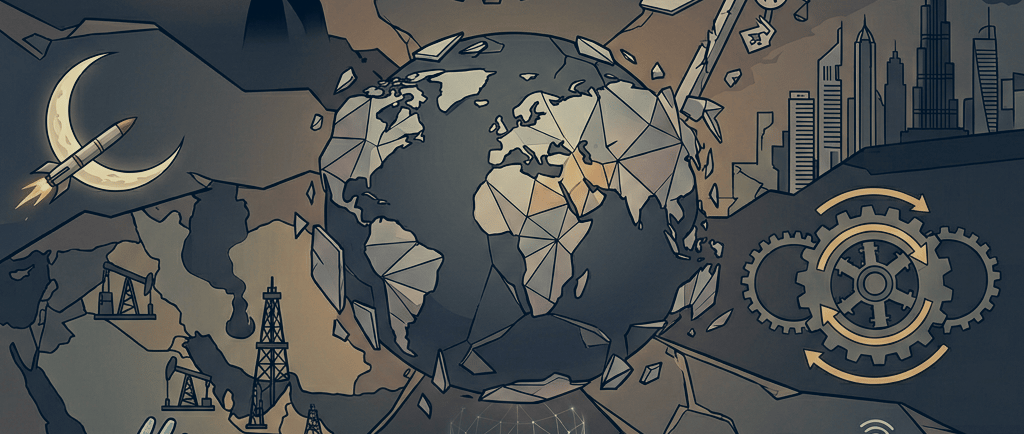
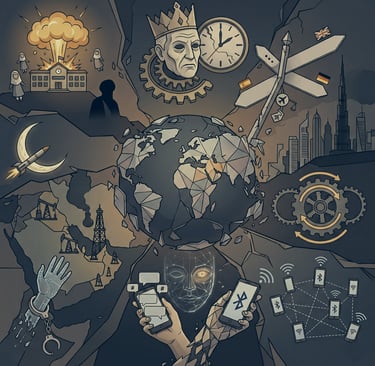
The world woke up on the morning of February 28, 2026, to shocking news that overturned all equations in the Middle East. A large-scale joint air operation by the US and Israel resulted in the death of Iranian Supreme Leader Ayatollah Ali Khamenei. However, the tragic strike on a primary school in Minab during the operations, which claimed the lives of 85 schoolgirls, caused the crisis to fracture not just a military fault line, but a massive humanitarian and psychological one as well.
Where we stand today, the fire has spread across the entire region with Iran's counter-attacks, dubbed the "Wrath of Zulfiqar." Yet, this war is not merely a frontline where missiles collide in the sky; it presents a colossal sociological laboratory where global alliances, unwritten rules, mass psychology, and economic illusions are shattered.
So, what naked truths has this crisis revealed to us about the world order and the human mind?
1. The Collapse of the "Religious Wars" Myth and the Cold Face of Realpolitik
When the Middle East is mentioned, the first cliché that comes to the masses' minds is that conflicts are always driven by religious motivation between "Muslims and the West/Israel." The masses are always fed fairy tales of "religion, sect, or ideology." However, there is no room for emotions or beliefs at the table of states; only Realpolitik speaks there.
This crisis fundamentally debunked that myth. As fighter jets struck Iran, the "deafening silence" exhibited by the Sunni Gulf Arab states (Saudi Arabia, UAE, Jordan) went down in history. For the Gulf countries, Iran is not a "Muslim neighbor" but rather the greatest national security threat to their own survival, given the militia networks it has established in Yemen, Lebanon, and Syria. For states, if foreign interventions mean weakening a rival that threatens their own regimes, rhetoric of "regional brotherhood" is instantly shelved.
2. The Sociological Dilemma of the Gulf and "Obedience in Exchange for Welfare"
The use of Western bases in the region for operations against Iran is causing a massive buildup of anger in the Arab street. It is possible to read this situation through the anti-imperialist spirit of the "6th Fleet Go Home" protests in Turkey in 1968. Today, the Gulf populations approach the jets taking off from their own lands to set the region ablaze with the same conscientious outrage.
However, the primary reason a mass uprising hasn't occurred in the Gulf is psychological and economic: The Rentier State System. The high-standard living offered to citizens through oil wealth has birthed a contract of "obedience in exchange for welfare" toward the state. When the state's heavy digital surveillance mechanisms are added to this equation, the massive gap between the public's conscience and the state's security policy can be suppressed for now. But a potential economic collapse resulting from the closure of the Strait of Hormuz is the biggest ticking time bomb that will break this vow of silence.
3. A Deep Rift in the Western Alliance: The Division of Europe
One of the most striking reflections of the crisis occurred within the psychological integrity of NATO and the European Union. The US's unilateral operation split the alliance into opposing camps:
Defenders of Law and Restraint (The Spain Model): Centering international law, Spain closed its military bases (Rota and Morón). By calling Washington's bluff in a historic move "not to be an accomplice to war," it pivoted to a psychology of border protection.
Logistical Subcontractors and Crisis (The UK Model): The UK took an active role by opening its bases on its soil and in Cyprus (Akrotiri). However, this created a massive wave of opposition in its domestic politics, putting the government in the crosshairs, accused of violating international law.
Passive Defense (The Germany Model): Germany, on the other hand, refused to join the active war, retreated to a strategy of solely protecting its own personnel, and made it clear it would not be dragged along by the crisis.
The clearest collapse of the security illusion occurred in Dubai. Marketed as the world's "safe oasis" and grown through massive investments of Western capital, the city transitioned to blackout protocols for civil defense. The darkened lights of the skyscrapers symbolize not only physical darkness but also the death of the illusion that "We are safe while the region burns." If there is no sense of security, there is no capital.
4. Gerontocracy and the Destructive Psychology of Power
Today, the fate of the world, nuclear codes, and massive economies are managed by a generation born in the 1940s, disconnected from the zeitgeist. This situation, termed Gerontocracy (rule by elders) in political science, carries a massive psychological risk for global peace.
The decision-making processes of elderly leaders are shaped less by empathy and more by concerns about "Leaving a Historical Legacy" and compensating for "Narcissistic Wounds." When a leader who has lost an election or taken a blow to their ego regains power, they can take far more destructive risks than before. For these leaders, radical decisions are the shortest path to etching their names in history. The bill, however, is paid by the youth sent to the frontlines.
5. The War Economy and the "Revolving Door"
We are facing a structure where giant energy cartels and arms manufacturers dictate state policies. The most flawless gear in this system is the "Revolving Door" mechanism.
Top-level bureaucrats retiring from ministries transition the very next day to the boards of funds managing trillions of dollars or giant arms companies. The system operates on the logic of "destroy first, then rebuild." Arms companies fund the war, energy companies rake in record profits from skyrocketing oil prices; and when the war ends, construction companies drag those nations into decades of debt to rebuild the ruined countries.
6. Biopolitics, the State of Exception, and Surveillance Capitalism
How can modern states control the masses so easily? The greatest psychological rehearsal for this was the Covid-19 pandemic. Italian philosopher Giorgio Agamben's theory of the "State of Exception" materialized here. States saw how obediently the masses could surrender their freedoms motivated by fear. Crises are the most functional tools for authority to expand its own boundaries.
So why do the people not rebel despite all this destruction? Because our anger is digitally absorbed. As explained by Byung-Chul Han's concept of Psychopolitics; in the past, masses facing injustice would take to the streets and force the system to change. Today, people vomit their anger by starting a hashtag on social media. When they see others who think like them, they experience a "digital catharsis" (a false relief), and their energy for action dissipates. While social media offers us the illusion of freedom, it provides governments with a flawless surveillance panel.
7. Underground Resistance Against Digital Shackles: Decentralized Networks
The entire communication infrastructure is in the hands of giant tech companies that can be shut down by a single "pull the plug" order from states. When things get out of hand, the masses are condemned to be deaf and blind.
However, every oppression births its own resistance. The Mesh Network and P2P (Peer-to-Peer) technologies developed against this eliminate centralized servers. In a scenario where the internet is cut, phones' Bluetooth and Wi-Fi receivers connect to each other, turning every single device into a live base station. Because there is no "master switch" that can be turned off, the masses can continue to communicate without censorship.
Conclusion: The Choice is Ours
The era we live in is not one of ignorance, but of being "numbed by over-information." We face leaders who prioritize their own survival above all else, trillion-dollar corporations, and massive surveillance networks. But as long as the system's loopholes and questioning minds exist, the possibility of pulling the plug on the Matrix is always on the table.
The real issue is how much courage we have to recognize this illusion and give up our digital comfort.
It is unknown when a ceasefire table will be set, but rebuilding these global dogmas destroyed by war will take decades.
[1] Dagres, H. (2026, February 28). Ayatollah Ali Khamenei obituary. The Guardian. https://www.theguardian.com/world/2026/mar/01/ayatollah-ali-khamenei-obituary
[2] Wikipedia contributors. (2026, March 4). Assassination of Ali Khamenei. Wikipedia, The Free Encyclopedia. https://en.wikipedia.org/wiki/Assassination_of_Ali_Khamenei
[3] McClure, T. (2026, March 1). Death toll from school bombing in southern Iran reportedly rises to 165. The Guardian. https://www.theguardian.com/world/2026/mar/01/iran-school-bombing-death-toll-us-israel-strikes
[4] Wikipedia contributors. (2026, March 4). 2026 Minab school airstrike. Wikipedia, The Free Encyclopedia. https://en.wikipedia.org/wiki/2026_Minab_school_airstrike
[5] Morgenthau, H. J. (1948). Politics among nations: The struggle for power and peace. Alfred A. Knopf.
[6] Beblawi, H., & Luciani, G. (Eds.). (1987). The rentier state. Routledge.
[7] Anadolu Ajansı. (2026, March 2). Spain says US has not used and will not use bases on its soil to strike Iran. https://www.aa.com.tr/en/europe/spain-says-us-has-not-used-and-will-not-use-bases-on-its-soil-to-strike-iran/3846799
[8] TRT World. (2026, March 3). Trump threatens total trade cut with Spain over Iran strike row. https://www.trtworld.com/article/a2b2abced93f
[9] Thomson Reuters. (2026, March 2). US aircraft leave Spain after government says bases cannot be used for Iran attacks. WHTC. https://whtc.com/2026/03/02/us-aircraft-leave-spain-after-government-says-bases-cannot-be-used-for-iran-attacks/
[10] Post, J. M. (2004). Leaders and their followers in a dangerous world: The psychology of political behavior. Cornell University Press.
[11] Wedel, J. R. (2009). Shadow elite: How the world's new power brokers undermine democracy, government, and the free market. Basic Books.
[12] Agamben, G. (2005). State of exception (K. Attell, Trans.). University of Chicago Press. (Original work published 2003).
[13] Han, B.-C. (2017). Psychopolitics: Neoliberalism and new technologies of power (E. Butler, Trans.). Verso Books. (Original work published 2014).
[14] Oram, A. (Ed.). (2001). Peer-to-peer: Harnessing the power of disruptive technologies. O'Reilly Media.
Contact
We offer a space for self-expression through experiences combine art and technology.
INFO
+905363506969
© 2025. All rights reserved.